My Personal take on a Madrasa by Mikyle Ossman
A Journey to Understand: Inside a Sri Lankan Madrasa
In the West, from my experience, there seems to be a general lack of knowledge and understanding of Islam and its teachings. Even though I was born into the religion, I realised that I too lacked a deeper understanding.
In light of global events and media narratives, particularly after the Easter bombings in Sri Lanka where over 250 innocent Christians were killed by extremists linked to ISIS, I found myself questioning what a Madrasa truly represented. Were they hubs of genuine Islamic scholarship, or were they places where extremist ideologies were preached against the West and communities back home?
Concerned and curious, I felt I needed first-hand experience to answer these questions for my 16-year-old self.
The Journey South
Last summer, while visiting Sri Lanka where most of my family resides, an opportunity arose to visit a Madrasa — a school devoted to higher education in Islamic studies. I was surprised to discover that many Madrasas are scattered across the island, even though Buddhism is the main religion and Muslims make up only 9% of the population.
What amazed me even more was that the particular Madrasa I planned to visit — Al Bahajathul Ibraheemiyyah Arabic (BIA) College — was established by my great-grandmother in 1892.
My journey began at 7:14 am from the picturesque Mount Lavinia station, just two minutes from the old residence of Sir Thomas Maitland, the second Governor of British Ceylon. I secured a window seat and watched the waves of the Indian Ocean roll alongside the train. The 100km journey down the west coast took two hours.
Upon arriving at Galle station, I took a tuk-tuk through the historic Galle Fort to the Madrasa.
First Impressions
I arrived at a pristine white building reading “Al Bahajathul Ibraheemiyyah Arabic College.” Lessons were already in progress. The principal welcomed me warmly, offering a late breakfast and explaining how the college operated despite his limited English.
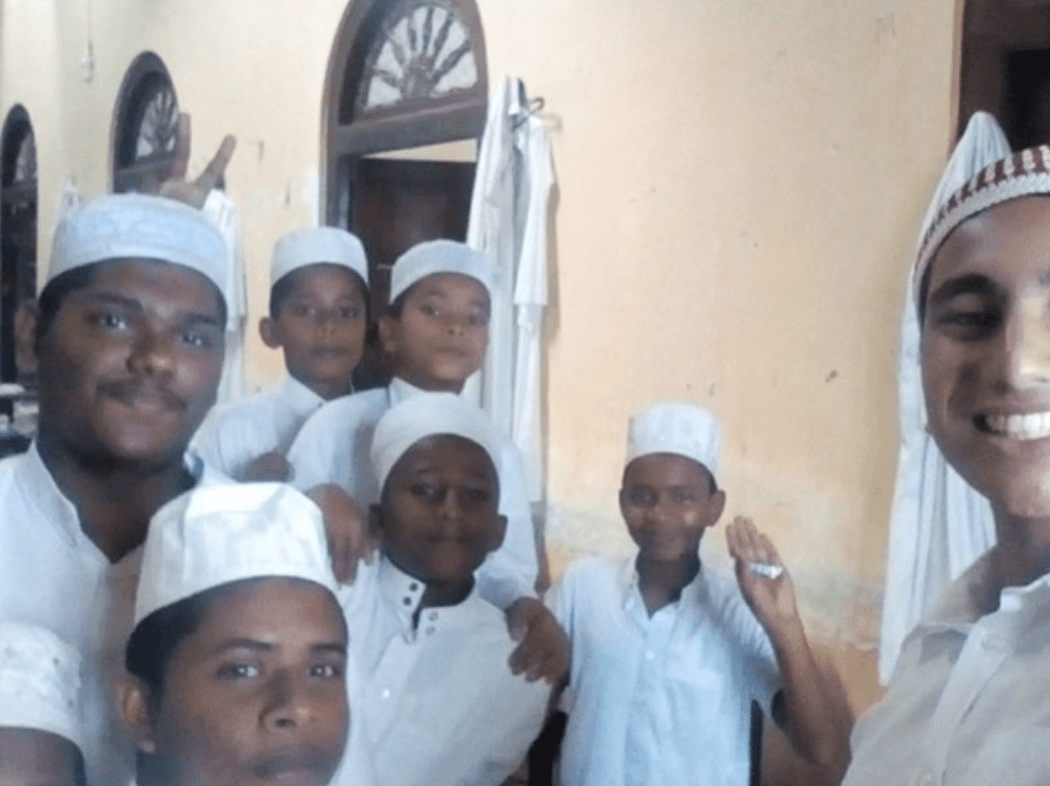
I met Hashad, a 21-year-old final-year student who spoke some broken English. Between his English and my limited Sinhala, I was able to communicate with the 30 or so students. I even stayed in their dormitory, which allowed me to truly observe daily life at the college.
Daily Life at the Madrasa
The day revolved around the five daily prayers — the second pillar of Islam.
The routine began at 4:00 am. Lights on, fans off, bell ringing — almost military in style. After morning prayer, the students recited verses from the Qur’an for about an hour.
Lessons began at 7:30 am after breakfast and free time (which I mostly used to catch up on sleep). Morning classes ended at 10:50 am, followed by a short rest period — necessary due to the early start.
The afternoon continued with prayers, lessons, free time, evening prayers, study preparation, Qur’an recitation, dinner, and bed.
While the structure seemed strict, I was surprised by the breadth of subjects taught. Beyond Arabic and Sinhala, students studied philosophy, logic, astronomy, and engaged in critical thinking and debate.
Challenging Stereotypes
The boys were just ordinary young men — kind, friendly, and humorous. The teachers shared close relationships with students, joking during lessons while maintaining respect.
Importantly, the students were deeply troubled by the actions of extremists. They were clear that terrorists were entirely to blame and expressed a sense of responsibility to promote a correct, moderate understanding of Islam within their communities.
One student, Zamrin, a 16-year-old with three years remaining at the Madrasa, particularly impressed me. His ambition was to unite the religions and races of Sri Lanka to live in harmony. His sincerity was striking, especially given the heightened Islamophobia in Sri Lanka following the Easter attacks.
Others had different aspirations — some hoped to work abroad, others to return as teachers or serve as imams in their communities. They proudly believed their Madrasa to be among the best in Sri Lanka.
A Changed Perspective
My limited time at BIA College did not reflect the stereotypical image often portrayed in the media. The students were well-educated, grounded, and thoughtful. They studied Islam deeply, but also subjects that broadened their intellectual horizons.
I cannot speak for every Madrasa in Sri Lanka or the wider world. But if others resemble BIA College even in part, then they are places of learning, discipline, and purpose — not extremism.
I must admire my great-grandmother, Marhooma O.L.M. Macan Markar, who founded the institution in 1892. Over its 127-year history, the college has produced scholars, imams, lecturers, principals, and Islamic orators who have served both the country and their faith.
God willing, their good work continues.
About the Author
My name is Mikyle Ossman. I am 16 years old and visited the Madrasa during my post-GCSE holidays. I attend Dulwich College as a sports scholar. I have played for the Surrey Under-12 County cricket team and have captained my school cricket team.
Similar Blogs
News, Voices & Impact
Explore updates, field notes, and stories that showcase our mission and impact.